
Cheshire West and Chester is the first council in England to face an LGA public health peer review. It passed, with seven recommendations to act on.
Cheshire West and Chester Council is the first council in England to go through a Public Health Peer Review under a new national programme, and the panel’s report says it is fulfilling its public health responsibilities well. It also says the council has too many priorities, a stretched public health team and an uncertain relationship with an NHS body that is being cut back, and it sets out seven recommendations.
The quick answer
- What: a Public Health Peer Review by the Local Government Association (LGA), the first in England under its Public Health Improvement Programme, funded by the Department of Health and Social Care.
- When: the panel spent three days with the council and its partners, 8 to 10 September 2026. The report is dated 1 October.
- Verdict: the council is fulfilling its statutory and mandated public health duties, with strong political leadership and partnership working.
- To work on: fewer, sharper priorities; capacity and succession in the public health team; influence over a reorganised NHS; more use of residents’ own experience.
- Next: the council has to produce an improvement plan within three months of the visit, overseen by the Department of Health and Social Care’s regional director for public health.
- Not an inspection: the report stresses the review is improvement focused, not a grade.
What the council says
Councillor Lisa Denson, the cabinet member for A Fairer Future (Poverty, Public Health and Mental Health), said in the council’s announcement:
“We were pleased to be the first council in the country to take part in this new process.
“We’re really proud of the work we do to improve health and wellbeing for people in the borough, particularly trying to break down the inequalities we see across different areas in our borough.
“There’s always more to do, and having that independent assessment of our work to help celebrate what we’re doing well, as well as help us to refine how we can improve, is vital to help us help our residents.”
How the review worked
The peer team was led by David Williams, chief executive of Eastleigh Borough Council, with Amanda Healy, Durham County Council’s director of public health, Councillor Kelly Middleton of Telford and Wrekin, Claire Robson, a public health consultant at Trafford Council, and a former NHS chief executive, Marcus Warnes, supported by LGA staff.
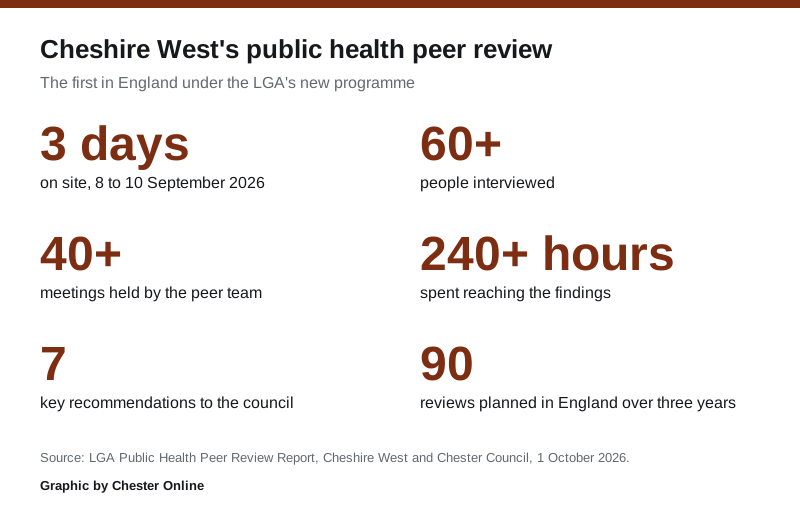
According to the report, over its three days in Chester the team spoke to more than 60 people, including council staff, councillors and outside partners, gathered views from more than 40 meetings, and spent more than 240 hours in all on its findings, “the equivalent of one person spending more than seven weeks onsite”.
It looked at six themes: leadership and governance; vision and priorities; partnership working; data, intelligence and outcomes; resources, quality and commissioning; and statutory responsibilities. The council also put five questions of its own to the panel, including whether its public health team has the capacity to deliver its priorities “while maintaining staff wellbeing and professional development”, and whether the public health grant is being spent in the right places.
What the panel praised
The report says the phrase “this is a Public Health-led Council” was “repeated with conviction” in many of its interviews, by councillors, officers and partners alike. It describes the council leader as “a passionate advocate for public health” and notes that the director of public health sits on the senior management team and reports directly to the chief executive, an arrangement it says is “not universal” elsewhere.
Among the strengths it lists:
- the council’s adoption in 2022 of the Marmot principles for reducing health inequalities, which the panel says is “strongly evidenced” in its strategies and policies;
- the community inspirers and the Poverty Truth Commission, which feed residents’ experience into policy, with examples such as clearer wording on housing rent arrears letters, device-lending libraries and a freephone number for Crisis Resilience support;
- the Healthier Advertising Policy and work on the siting of fast-food outlets and the contents of vending machines;
- a “very strong” record on health protection and a good relationship with the UK Health Security Agency;
- data work the panel calls impressive, including a Social Isolation Dashboard that Age UK used to support a grant bid, and links with the University of Chester such as the annual Haygarth Public Health Lecture.
It also praised what it called “a talented, professional, enthusiastic, and committed public health workforce”.
What it wants changed
The report is just as direct about the gaps. It says turning ambitions into better outcomes “is proving to be a challenge in some areas”, naming persistent inequalities in school attendance, self-harm among 10 to 24 year olds, falls-related hospital admissions for older people, and the share of adults who are overweight or who smoke.
On priorities, it counts three public health priorities, six missions in the Borough Plan and eight priorities in the Joint Health and Wellbeing Strategy, and quotes one interviewee: “everything is a priority and it’s hard to know where to start.”
Its seven key recommendations are:
- Be bold in keeping up progress as a Marmot Council.
- Review the public health priorities for the whole council, to focus them and match them to the resources available.
- Look at the capacity and make-up of the public health team, with a staff succession and development plan.
- Build a shared understanding of how the council can influence partners in the changing health system.
- Take the initiative in shaping the neighbourhood health model with the NHS and others.
- Collect more qualitative evidence of people’s lived experience, alongside the statistics.
- Raise awareness of the core public health priorities across everything the council does.
Other points in the body of the report:
- The NHS shake-up. Concerns about the restructuring and downsizing of the Cheshire and Merseyside Integrated Care Board came up repeatedly. The panel was told there will no longer be an ICB place director or place team for Cheshire West and Chester, one of nine places in that system, which “may have detrimental consequences for joint working”.
- Leisure spending. The panel says “significant Public Health Grant funding is being invested in leisure services”, and that the council must keep showing the grant is spent across the full range of public health duties.
- Mental health. It calls mental health “a key area for further development” and suggests the council could lead on prevention, including “reversing costly out of area mental health placements” and building more community support.
- Health checks. NHS Health Checks are commissioned from every GP practice, but the report says their effect on outcomes, and the gap between poorer and better-off areas, “is less clear”, and the money spent on them could be reviewed.
- An older population. It asks the council to weigh Ageing Well in its priorities, given an estimated 22% growth in residents aged 65 and over by 2030.
- The health board. It suggests the cabinet member for public health becomes a voting member of the Health and Wellbeing Board.
What it means for you
Nothing changes in services straight away: this was a review, not an inspection, and no rating was given. The test is the improvement plan the council now has to write within three months of the September visit, which puts it due by early December. That plan should show which of the council’s many health priorities survive the panel’s call to focus, and whether mental health, falls among older people and school attendance move up the list.
Cheshire West will not be the last. The LGA says 90 of these mandated reviews will be carried out over the next three years, after the government’s 10-Year Health Plan committed every upper-tier and unitary council in England to a regular review.
The full report is published on the council’s website.
Have your say