
Cheshire West moves bin days only at Christmas, never for bank holidays. Plus the four bin colours, £55 garden waste and the new tip registration.
Cheshire West and Chester runs four containers at every house, collects one of them weekly and the rest on a fortnightly rota, and publishes ten round calendars that almost nobody reads. Those calendars answer the question the council’s web pages do not: what happens on a bank holiday. This page pulls the whole cluster together, with the price of every chargeable part checked against the council’s own fees schedule for the year that started on 1 April 2026.
The bank holiday answer: nothing changes
This is the recurring worry and the recurring surprise. In Cheshire West, bank holidays do not move your bin day. The council publishes a separate calendar for each round, and the only dates flagged as changed across the whole of the current calendar are the ones around Christmas and New Year.
Read the Monday Week A calendar and the Monday collections run 6 April (Easter Monday), 4 May, 25 May and 31 August exactly as normal, on the day, in the usual weekly pattern. The Wednesday Week B and Tuesday Week A calendars do not carry the “changed day” legend at all, because those rounds have no changed date in the entire year.
Christmas is the exception, and the change is not always a delay. On the current calendar the Monday round moved forward to Saturday 20 December 2025 in place of Monday 22 December, the Thursday Week B round moved forward to Monday 22 December in place of Christmas Day and then out to Saturday 3 January in place of New Year’s Day, and the Friday Week A round moved back to Saturday 27 December in place of Boxing Day. Some rounds were not touched at all: Wednesday Week B collected on 24 and 31 December as usual.
The calendars run to November 2026, so the festive dates for Christmas 2026 have not been published yet. When they are, they will appear on the same bin collection pages, and your own round is the one to check, not your neighbour’s.
The four containers, and what goes in each
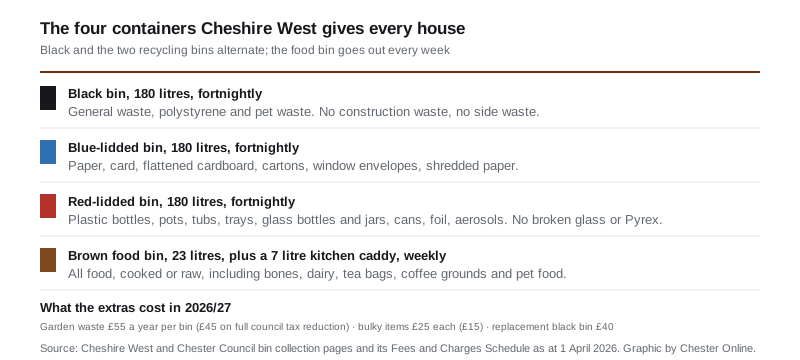
Every property on the standard service gets one 180 litre black bin, two 180 litre recycling bins, a 23 litre food bin and a 7 litre kitchen caddy. The two recycling bins are told apart by their lid colour, which is the part that trips up people who have moved here from a council that uses boxes.
- Blue lid, fortnightly. Paper, card, cardboard boxes, corrugated card flattened and folded, cartons, envelopes with windows and shredded paper.
- Red lid, fortnightly. Everything else that recycles: clean plastic bottles, lids, pots, tubs and trays, glass bottles and jars, cans and tins, foil and foil trays, empty aerosols, and black plastic packaging. The council is explicit that it will not take broken glass, panes of glass or Pyrex in this bin.
- Brown food bin and caddy, weekly. Bread, cakes and pastries, dairy, eggs, fruit and vegetables, raw and cooked meat and fish including bones, rice, pasta, beans, tea bags, coffee grounds and pet food.
- Black bin, fortnightly. General waste, plus polystyrene and pet waste. No construction waste.
The full accepted and rejected lists are on the council’s what goes in my bin/box/bag page, which also names the common refusals: cling film, light bulbs, paint cans and vapes.
The black bin and the two recycling bins alternate, so in any given week you put out either the black bin or one of the recycling bins, and the food caddy every week either way. Containers must be out before 6am, and side waste is not taken: anything left beside or on top of the bin stays there.
Find your day
The council’s collection day lookup takes your address and returns your day and week letter. Once you know it, the matching round calendar (Monday to Friday, Week A or Week B) is the document worth saving, because it shows the whole year including any festive change.
Missed collections: three working days
The window is short and specific. Missed collections must be reported within three working days of the collection date. Before you report, the council asks you to check that the bin was out before 6am, since crews have until 6pm to reach you, and that the whole street has not simply been delayed by a re-route.
The three reasons crews leave a bin: the wrong waste is in it, extra bags have been left beside it, or it is too heavy to lift safely.
Garden waste is a paid subscription: £55
Garden waste is not free here. The subscription costs £55 per bin per calendar year regardless of when in the year you join, with a £45 rate for households on full council tax reduction. An additional bin is another £55. Bins are emptied fortnightly across 40 weeks, and in 2026 collections run from Monday 9 March to Friday 11 December. Without a valid subscription and a displayed permit, the bin is not emptied.
Both figures match the council’s fees and charges schedule as at 1 April 2026, which is the document to trust if a web page and a leaflet ever disagree.
Bulky collections: £25 an item, with generous bundling
A bulky collection is £25 per item, or £15 for households on council tax reduction (single person discount alone does not qualify). There is no cap on the number of items, and the definition of “one item” in the fees schedule is worth knowing before you book several:
- a three piece suite counts as one item
- a table and six dining chairs counts as one item
- a mattress, bed base and headboard counts as one item
- carpet and underlay from one room counts as one item
Items need to be outside the property, collections start from 8am, and a refund is only possible within 14 days of payment and only if nothing has been collected. Upholstered seating is taken away separately from the rest on the same day, because it may contain persistent organic pollutants.
Replacement bins are chargeable, and repairs are cheaper
A lost or damaged 180 litre black bin is £40, a blue or red recycling bin £30, a 55 litre green or grey box £15 and a box lid £9. Households on full council tax reduction get £10 off a bin and £5 off a box, on production of a council tax reference or bill.
Since May 2025 there has also been a repair service: lids, pins, wheels and axles are repaired for £15, or £10 on full council tax reduction, and if the repair turns out to be impossible the payment comes off the price of a new bin. Food waste containers are replaced free. Garden bins are replaced free if you hold a subscription.
The tip: you now have to register, and you get 30 visits
This is the biggest change to the service in years and it landed on 20 July 2026. Every household must now register its vehicles online before using any of the seven recycling centres. Automatic number plate recognition reads the plate at the gate, so there is no proof of address to carry and no paper permit, and the old paper system at Neston has gone.
The numbers that matter:
- 30 visits per household in any 12 month period, with more available on request, conditions applying.
- Up to three vehicles per household, including one commercial-type vehicle such as a van or pickup.
- A hire vehicle can be used up to four times in 12 months, but you must register it in advance, present the emailed QR code to staff on arrival and produce the hire documents. Missing either can mean being turned away.
- Registration is once per household, updated only if you change vehicle or move.
The council’s own framing is that the sites are for household waste from Cheshire West residents, and that a sharp rise in frequent visits and suspected trade waste, particularly in commercial-type vehicles, is what prompted the change. The seven sites take around 740,000 visits and 40,000 tonnes a year between them, and since April 2026 they have been run by Cheshire West Recycling, a company wholly owned by the council. An unregistered vehicle can be refused entry.
The seven recycling centres
Addresses are as published in the council’s registration announcement; hours are the April to September summer hours from each site’s own page.
| Site | Address | Summer hours |
|---|---|---|
| Chester | Bumpers Lane, off Sealand Road, CH1 4LT | Mon to Fri 8am to 8pm, Sat and Sun 8am to 6pm |
| Ellesmere Port | Garth Road, CH65 4LB | Mon to Fri 8am to 8pm, Sat and Sun 8am to 6pm |
| Winsford | Leslie Road, CW7 2RB | Mon to Fri 8am to 8pm, Sat and Sun 8am to 6pm |
| Northwich | Marbury Lane, off Leicester Street, CW9 5LN | Mon and Tue, Fri to Sun 9am to 5pm, closed Wed and Thu |
| Frodsham | Station Yard, off Church Street, WA6 6PN | Mon and Tue, Fri to Sun 9am to 5pm, closed Wed and Thu |
| Neston | Clayhill Industrial Estate, CH64 3RL | Mon, Thu to Sun 9am to 5pm, closed Tue and Wed |
| Tattenhall | Red Lane, CH3 9BD | Mon, Thu to Sun 9am to 5pm, closed Tue and Wed |
Two traps in that table. The four smaller sites are shut two days a week, and the closed days differ between the Northwich and Frodsham pair and the Neston and Tattenhall pair, so a wasted trip is easy. And four of the seven cannot take sofas, armchairs, upholstered dining chairs or beanbags at all: Frodsham, Neston, Northwich and Tattenhall all say so on their own pages, because those items need a separate skip and the sites lack the room. For upholstered seating, use Chester, Ellesmere Port or Winsford, or book a bulky collection.
Other site rules worth knowing: Chester takes no asbestos, gas cylinders or tyres, refuses trailers over 3.5 metres and vehicles over 3.5 tonnes, and will not accept waste brought in on foot. Neston refuses trailers over 2.5 metres. Every site may shut its gates early if the light goes.
At Christmas 2025 the council’s position was that all sites close on Christmas Day, Boxing Day and New Year’s Day with no other festive changes to opening times.
Related pages
- Parking in Chester for car park tariffs, permits and the free bays.
- Chester council tax bands, including what the full council tax reduction that unlocks the discounted waste rates is worth.
- Chester roadworks and travel for the closures that occasionally push a round off its route.
Have your say