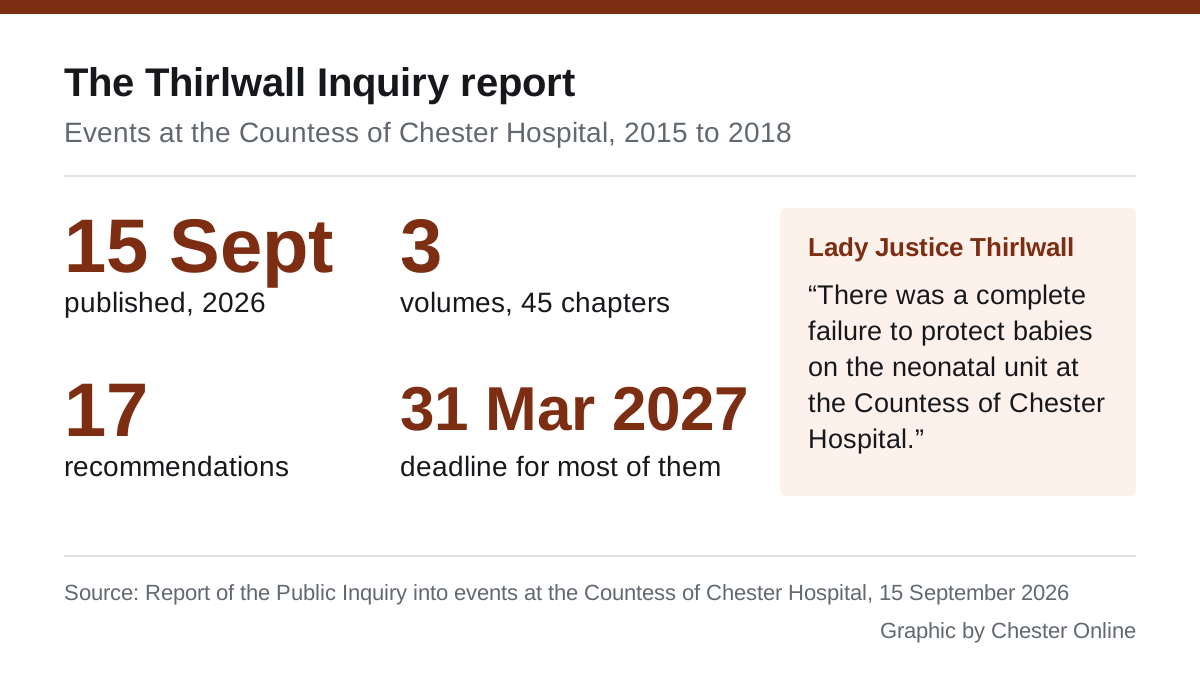

Lady Justice Thirlwall's report makes 17 recommendations, most due by 31 March 2027. Three former Countess leaders are still on police bail.
Lady Justice Thirlwall published her report into events at the Countess of Chester Hospital on Tuesday 15 September. It makes 17 recommendations. Most of them carry a deadline of 31 March 2027.
The inquiry was set up in 2023 to examine those events and their implications following, in its own words, “the trial, and subsequent convictions, of former neonatal nurse Lucy Letby of murder and attempted murder of babies at the hospital”.
The report was presented to Parliament under section 26 of the Inquiries Act 2005 and runs to three volumes and 45 chapters, with a separate summary report and a separate recommendations document.
Delivering it, Lady Justice Thirlwall said: “There was a complete failure to protect babies on the neonatal unit at the Countess of Chester Hospital. This was because no-one seems to have understood that safeguarding action is required when a member of staff is suspected of causing deliberate harm and does not require colleagues to be sure of guilt.”
The inquiry has asked everyone commenting on the report to remember that the parents “have suffered grievously and continue to suffer”, and that their dignity and courage should be respected. Reporting restriction orders made in the Crown Court still apply, which is why the report refers to the babies, their parents and some of the medical staff by cipher rather than by name.
What the report found
The inquiry’s own summary of its findings is blunt. It describes “dysfunctional management and governance; a gulf between hospital leadership and clinicians; and failure to understand the fundamentals of safeguarding”.
The specific findings the inquiry set out on publication:
- The collapse and deaths of some babies could have been avoided had safeguarding practices been followed.
- Senior nurses never accepted that the consultants’ concerns were, or might be, justified.
- There was a prolonged delay by senior managers in calling the police.
- Successive internal and external reviews commissioned after concerns were raised did not address whether deliberate harm was being caused.
- Rather than being believed, clinicians were themselves made the subject of investigation within the grievance process. Three consultants were told to apologise, and plans were formulated, though later abandoned, to bring the nurse back onto the neonatal unit.
- Parents were kept in the dark for years. Their consent was not obtained before their babies’ medical records were shared with external experts and other organisations, and only in 2018 did they learn the deaths may have been the result of deliberate harm.
On the Royal College of Paediatrics and Child Health review, the report says that, as the college itself accepted, the service review it carried out “could not and did not address the doctors’ concerns and should never have been undertaken”.
The inquiry also records that the hospital’s safeguarding policy at the time did not mention the possibility of deliberate harm by a member of staff, and that to this day there is still no NHS-wide protocol on deliberate harm.
What the report says about the Countess today
Chapter 28 of the report, headed “The current position”, is the part most directly about the hospital as it is now. It is short, and it is not unkind.
The inquiry notes that “in 2025, the Countess opened an impressive combined facility for women and children”, and that this includes the current neonatal unit, which opened in 2021 and “occupies a larger, modern space where family integrated care is facilitated”. Parents are encouraged to attend ward rounds, and babies’ cots are next to their mothers.
It also records that the trust has a Safeguarding and Promoting the Welfare of Children Policy dated 1 September 2022, which “specifically addresses the possibility that a member of staff may have harmed a child, committed a criminal offence or displayed behaviours which may indicate that they are not suited to work with children”, and which directs a referral to the local authority designated officer. The report calls that “a welcome and important improvement”.
That is the inquiry’s verdict on the hospital now, and it is worth separating from its verdict on the hospital then.
The 17 recommendations, and when they are due
The recommendations are set out in chapter 45 and published as a standalone document. They apply to the NHS in England, not only to Chester.
The ones a parent is most likely to notice:
- Cameras over every cot. Recommendation 1 says all cots and incubators in all neonatal units should be fitted with in-cot cameras with livestreaming video, so parents can watch their baby remotely at any time. The funding should be “centrally managed and ring-fenced”, and NHS England should set out a roadmap by 31 March 2027.
- Insulin under lock and camera. Until access to insulin is controlled by biometric data, every trust should install CCTV cameras focused on the fridges and cupboards where it is stored, keeping recordings for at least 28 days.
- A one-page protocol on deliberate harm. NHS England must produce, by 31 March 2027, a one-page Suspicion of Deliberate Harm Protocol setting out what a manager does when someone says a colleague may be harming patients. It must say explicitly that it does not matter whether the person hearing the concern believes it, that moving the suspected person is “a neutral act”, and that safeguarding steps must be followed, “as a result of which the police will become involved”.
- Every death of a baby or child seen by the board. By 31 March 2027 every trust must have board-level monitoring of all deaths of children and babies, and a predetermined route for escalating concerning trends.
- Safeguarding written into every contract. By March 2027 every existing NHS contract of employment, including agency and bank staff, must oblige the employee to follow the safeguarding guidance, with the same duty in all new contracts.
The report also goes after NHS management as a profession. Recommendation 13 calls for a barring system for all managers, clinical and non-clinical, by September 2027, a review in 2030 and full statutory regulation by September 2032. It says the NHS Leadership and Management Framework Code published in July 2026 must be amended urgently to put, at the very beginning, a duty every manager can recite: “I will make the care and safety of patients my first concern and act to protect them from risk.”
And it is sharp about the Care Quality Commission. Recommendation 14 says inspectors “should investigate what is happening in hospital departments and not accept what they are told at face value”, and that inspections of neonatal services must not be “a box-ticking exercise”.
One recommendation exists because previous inquiries were ignored. Recommendation 17 gives the National Audit Office a new job, auditing whether the recommendations of statutory inquiries into NHS bodies are actually implemented, with funding so it can start by September 2027.
Behind several of these sits a workforce problem the Royal College of Pathologists calls a crisis. The UK has 52 paediatric and perinatal pathology consultants, 43 of them in England, with 37% of consultant posts vacant and only 13 doctors in specialist training. One in five bereaved families now waits six months or more for a post-mortem examination of their baby or child, and some wait longer than a year. Recommendation 12 sets a target of 37 doctors in training by June 2033.
What is still open in Chester
The report is not the end of it locally. Two processes are still running.
The criminal investigation. Cheshire Constabulary said on the day of publication that it will “carefully review the contents of the report and fully consider any relevant recommendations” in light of its own continuing work. The force set out where that work stands:
- Operation Duet was launched in October 2023 as an investigation into corporate manslaughter at the Countess of Chester Hospital, focused on senior leadership and decision-making.
- In March 2025 its scope widened to include gross negligence manslaughter, which concerns the actions or inaction of individuals rather than the organisation.
- On 30 June 2025, three people who were part of the senior leadership team at the hospital in 2015 and 2016 were arrested on suspicion of gross negligence manslaughter. They were bailed and remain on bail.
- On 22 April 2026, officers executed a search warrant at a property in connection with Operation Duet and arrested an individual on suspicion of perverting the course of justice. That person was also bailed and remains on bail.
The force says all of them remain on bail and it has not named anyone. An arrest is not a conviction.
The inquests. The report records that the inquest into the death of Baby D was adjourned in 2017, reopened in February 2026 and adjourned again, and that inquests opened and adjourned for Baby I, Baby O and Baby P have also been reopened and adjourned again. The Senior Coroner for Cheshire had been notified of all the deaths at the time.
What the hospital says
Jane Tomkinson OBE, chief executive of the Countess of Chester Hospital NHS Foundation Trust, issued a response on the day of publication.
“We know that no apology or action can undo what happened at our hospital. We are however truly sorry for the events that occurred in 2015 and 2016,” she said. “We are a different organisation today with new leadership, stronger governance and safety processes, and a more open culture where speaking up is encouraged and acted upon.”
She added that the trust “acknowledges however that there is more to be done”, and that its priority is to address the recommendations “as swiftly as possible, whether through ensuring that actions we have already taken are sustained or by taking further action where needed”.
What it means for you
If you have a baby on the neonatal unit at the Countess, nothing changes this week. The recommendations are directed at NHS England, the Department of Health and Social Care and trusts in general, and the dated deadline on most of them is 31 March 2027. In-cot cameras are not something you can ask for yet: what is due by that date is a roadmap for putting them in.
One recommendation is meant to move faster than the rest. NHS England must “immediately” tell every trust with a neonatal unit that the sudden unexpected death process applies to babies who have never left hospital, and direct trusts to put that in front of relevant staff and their board within seven days.
If you are worried about a patient right now, the hospital already runs an escalation route you can use without going through the ward. Call 4 Concern is the Countess’s version of Martha’s Rule, and it lets a patient, relative or carer ring a dedicated team directly if they think someone is deteriorating and it has not been picked up. The trust published its own figures in 2026: it has been used 107 times since being rolled out across the main hospital in April 2025, with more than a third of calls, 36%, leading to a rapid assessment by the critical care outreach team. Information on how to use it is given to patients on arrival.
If you are following the criminal investigation, expect a long wait and few updates. Cheshire Constabulary has made arrests under Operation Duet on two occasions, in June 2025 and April 2026, and says everyone arrested remains on bail. It has not set a timetable.
If you want to read the report rather than read about it, the summary report is the place to start, and the recommendations run to nine pages. Both are free.
Our other coverage of the hospital includes its cancer waiting times, where the Countess has been running ahead of the England average.
Frequently asked questions
What is the Thirlwall Inquiry?
A statutory public inquiry set up in 2023 to examine events at the Countess of Chester Hospital and their implications, following the trial and subsequent convictions of former neonatal nurse Lucy Letby. It was chaired by Lady Justice Thirlwall, and its report was presented to Parliament under section 26 of the Inquiries Act 2005 on 15 September 2026.
How many recommendations does the Thirlwall report make?
Seventeen, set out in chapter 45 and published as a separate nine-page document. Most carry a deadline of 31 March 2027. The longest runs to June 2033, for training 37 paediatric and perinatal pathologists.
What does the report say about the Countess of Chester today?
Chapter 28 notes that the trust opened a combined women and children’s facility in 2025, that its neonatal unit opened in 2021 in a larger, modern space with family integrated care, and that its safeguarding policy dated 1 September 2022 now specifically covers the possibility that a member of staff may have harmed a child. The inquiry calls that “a welcome and important improvement”.
Is anyone being prosecuted over the Countess of Chester?
No charges have been announced. Cheshire Constabulary’s Operation Duet is investigating corporate manslaughter and gross negligence manslaughter. Three people who were part of the hospital’s senior leadership team in 2015 and 2016 were arrested in June 2025, and a further individual was arrested in April 2026 on suspicion of perverting the course of justice. The force says all of them remain on bail.
Will hospitals have to put cameras over cots?
Recommendation 1 says all cots and incubators in all neonatal units should have in-cot cameras with livestreaming video so parents can watch remotely, with central ring-fenced funding. What is actually due by 31 March 2027 is an NHS England roadmap for how that would be delivered, not the cameras themselves.
Where can I read the Thirlwall report?
On the inquiry’s own website, free. There is a summary report, a nine-page recommendations document and three volumes of the full report, all available as HTML or PDF.
Sources
- The Thirlwall Inquiry: The Report, presented to Parliament under section 26 of the Inquiries Act 2005 and ordered by the House of Commons to be printed on 15 September 2026, with the summary report and recommendations
- Inquiry news release, 15 September 2026 (the Chair’s statement, the findings and the reporting restrictions)
- Report, Volume II, Chapter 28: The current position (the Countess today, the 2022 safeguarding policy, and the pathology workforce figures)
- Cheshire Constabulary statement, 15 September 2026 (Operation Duet, the arrests and the bail position)
- Countess of Chester Hospital NHS Foundation Trust response and its Call 4 Concern figures
Reporting restriction orders made in the Crown Court under sections 45 and 46 of the Youth Justice and Criminal Evidence Act 1999 continue to apply to this subject. This report follows the inquiry’s own use of ciphers and names no one the inquiry or the police have not named.
Have your say