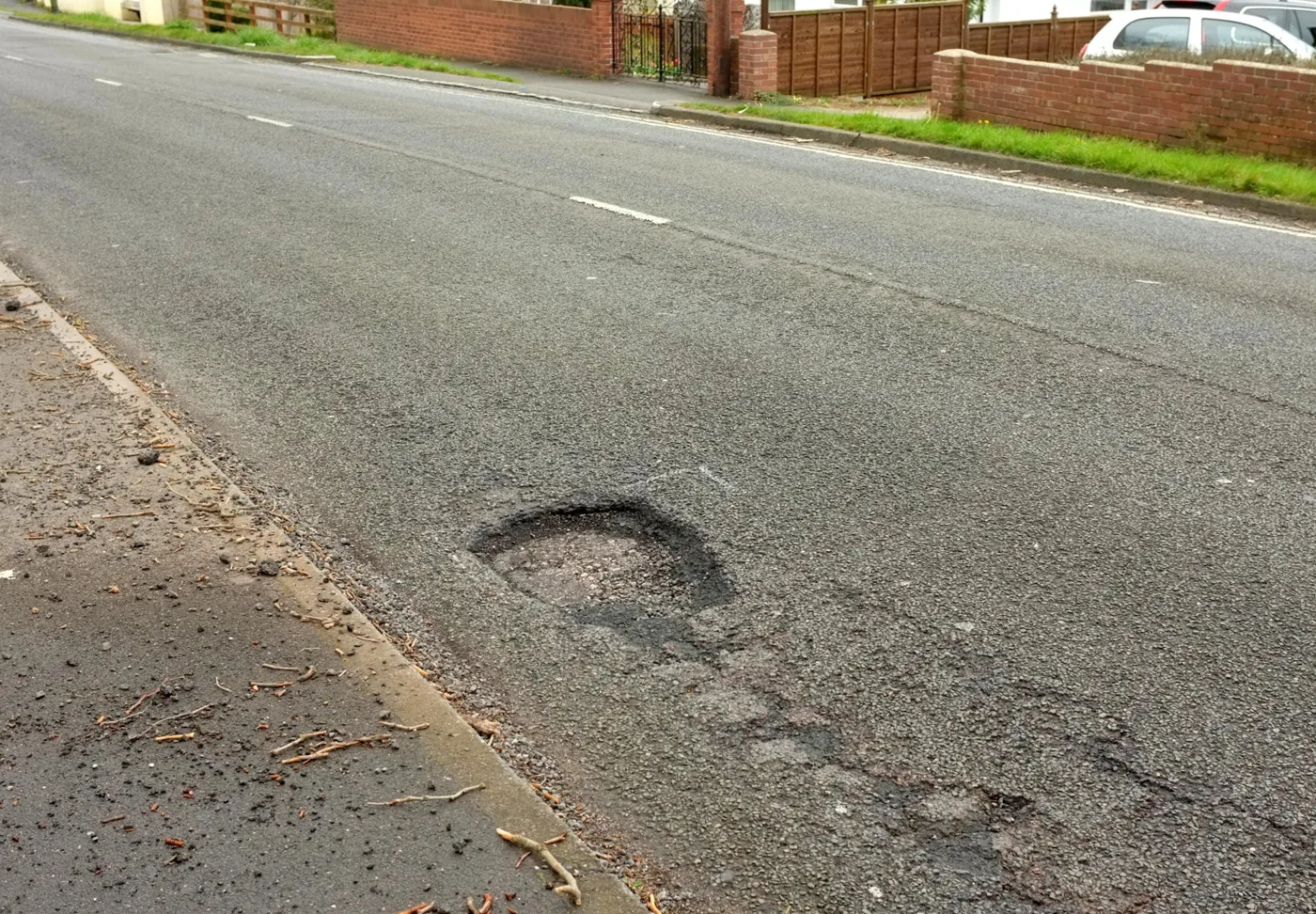

Damage claims against Cheshire West's roads peaked at 1,367 in one year and the council's own auditors gave its handling of them limited assurance.
Drivers made 1,367 claims against Cheshire West and Chester Council for damage done by its roads in a single year, and the council’s own internal auditors have now rated its handling of those claims “Limited Assurance”.
The finding is set out in an internal audit summary published in the papers for the Places Overview and Scrutiny Committee, which considered it on Monday 7 September. The audit was finalised in March 2026 and sent to scrutiny by the Audit and Governance Committee, which asked for it to be looked at properly rather than noted.
Two numbers explain why. The volume of property damage claims more than quadrupled in two years. And the share the council successfully rejected fell from three quarters to half, so far more of them now cost money.
Claims went up, refusals went down
The council maintains 1,450 miles of road and 1,250 miles of pavement. Under section 41 of the Highways Act 1980 it has a duty to keep them in repair, and where it fails and a vehicle or a person is hurt, a claim can be made against it.
| Year | Property damage claims | Rejected | Average cost |
|---|---|---|---|
| 2021-22 | 289 | 76% | £704 |
| 2022-23 | 554 | 50% | not stated |
| 2023-24 | 1,367 | 50% | not stated |
| 2024-25 | 741 | 55% | £350 |
The 2022-23 figure was a 92% rise on the year before. The 2023-24 figure was a further 147% rise. Even after the fall to 741 in 2024-25, the council was still above the maximum of 600 claims a year set in its contract with its insurance handler, Zurich Insurance UK, which the audit says has raised concerns about it. The contract maximum has now been exceeded in two consecutive financial years.
Personal injury claims moved the other way. There were 82 in 2024-25, the number has been falling steadily, and the council rejected 92% of them. The average cost of a personal injury claim fell from £12,725 in 2021-22 to £2,980 in 2024-25. Auditors note those averages can rise again as the bigger, slower cases settle.
Cheshire West is an outlier locally. Benchmarking against six other North West councils found none of them saw the same spike in 2022-23 and 2023-24, and all but one achieved a higher overall rejection rate in 2024-25. The auditors add the fair caveat that the six comparators all manage smaller road networks.
Why the claims arrived
The audit puts the surge down to three things happening at once:
- The government’s highways maintenance grant fell for four years. At £15.6m in 2025-26 it is back to roughly its 2020-21 level, but the intervening years cut maintenance activity. The council itself allocated £21.2m of capital for highways network management in 2025-26.
- A new highways contractor, Colas, took over in April 2023. Auditors record problems with the outgoing contractor at the end of 2022-23 and “teething problems” with the new one at the start of 2023-24, which delayed pothole repairs.
- The condition of the roads slipped, and the survey data shows it.
Between 2020 and 2025 the proportion of the borough’s A roads rated green, meaning no further investigation needed, fell from 40% to 25%. For B and C roads it fell from 30% to 16%. For comparison, the 2024 average across councils was 68% green for A roads and 63% for B and C roads.
The inspections that decide whether you get paid
Whether a claim succeeds usually turns on whether the council can show it inspected the road properly. On that, the audit is blunt.
The council’s own Inspection Policy and Code of Practice says a carriageway inspection should be done by two people, one driving and one observing and recording. The Highways Claims Engineer estimates that around 75% of claim payouts are the result of single-driven inspections, where nobody was watching the road but the driver.
A further estimated 10% of payouts follow inspections that were simply missed. There is no exception report that flags a missed inspection; the only way to find one is to count afterwards. In the audit’s own sample of claims, one road had been missed on three consecutive occasions, and that was the reason the claim was paid.
The other governance findings are worth reading in full, but the short version:
- The Inspection Policy and Code of Practice was last approved by Cabinet in 2018, and inspection frequencies are not routinely reviewed so that claim hotspots get looked at more often.
- The Local Transport Plan still in force, LTP3, was adopted in 2011 and refreshed in 2017. The Highways Management Asset Strategy dates from 2019. Both are being updated and the timetable has slipped.
- Two claims of more than £25,000 were paid in 2025-26 and signed off by the Highways Claims Engineer, when the council’s own scheme of delegation says the Corporate Insurance team should authorise them.
- Claims are logged twice, on a highways spreadsheet and on the corporate Claim Control system, and the reason a claim was paid or refused is no longer recorded, which the auditors say makes trends hard to spot.
- There are no formal performance targets for claims handling at all.
There were positives. Auditors tested a sample and confirmed every claim had been thoroughly reviewed before a decision, with a full audit trail. A member-level Highways Board reviews the data and has a dashboard showing where defects were reported and repaired.
How long a claim takes, and what happens next
Auditors measured the average number of days to process a claim from the point it reached the insurance handler:
| Year | Personal injury | Property damage |
|---|---|---|
| 2022-23 | 221 days | 247 days |
| 2023-24 | 241 days | 231 days |
| 2024-25 | 150 days | 147 days |
At the time of the audit, across those three years, 142 personal injury claims and 481 property damage claims were still unsettled.
The council is also going after its contractor. An exercise to identify claims paid out because Colas was at fault, through delayed repair, has found up to 500 possible cases since the contract began in April 2023. The audit says both sides know their contractual obligations but that it has taken time to agree how the recharging would work.
Separately, the council is trialling fraud detection technology called Clearspeed, which assesses a claimant’s answers in a telephone survey for signs of dishonesty. Auditors note the council currently receives no information from its insurance handler about claims that handler is investigating as potentially fraudulent.
Nine actions were agreed with managers when the report was finalised in March 2026, for completion by the end of June 2026. Some are recorded as already done.
What it means for you
If a pothole has damaged your car, the audit tells you something the claim form does not. Just over half of property damage claims are refused, so a rejection is the normal outcome rather than a sign your case was weak. If yours is refused, the council has to be able to show it inspected that road at the right frequency and found nothing.
Ask for that. The audit’s own finding is that missed inspections and single-driven inspections lie behind most successful claims, so the inspection record for your road on the relevant date is the document that matters.
Expect it to take months. The average property damage claim took 147 days to process in 2024-25, and that figure only covers time after the claim reached the insurer.
Report the defect regardless of whether you claim. The council’s live roadworks page carries its reporting routes, and a reported defect that is not repaired in time strengthens the next person’s claim as well as yours. What is being resurfaced and when is on our Chester roadworks and travel page, which is updated through the week.
Frequently asked questions
Can I claim from Cheshire West and Chester for pothole damage?
Yes. Under section 41 of the Highways Act 1980 the council must maintain the highway, and where it has failed and that failure damaged your vehicle or injured you, a claim can be made. The council received 741 property damage claims and 82 personal injury claims in 2024-25.
How many pothole claims does the council reject?
It rejected 55% of property damage claims in 2024-25 and 92% of personal injury claims. The property damage figure was 76% in 2021-22, so refusals have become less common as claims have risen.
How long does a highways claim take in Cheshire West?
An average of 147 days for property damage and 150 days for personal injury in 2024-25, measured from when the claim reached the insurance handler. At the time of the audit 481 property damage claims and 142 personal injury claims from the previous three years were still unsettled.
What condition are Cheshire West’s roads in?
By the council’s own survey data, 25% of A roads were rated green in 2025, down from 40% in 2020, and 16% of B and C roads, down from 30%. The 2024 average across councils was 68% for A roads and 63% for B and C roads.
What does “Limited Assurance” mean?
It is the rating the council’s internal auditors apply when the controls they examined do not give adequate assurance over the risks involved. Two highways reviews were scored that way, on insurance claims and on the management of high-risk assets, and both were referred to scrutiny by the Audit and Governance Committee on 17 March 2026.
Sources
- Summaries of Internal Audit Reports Scored as ‘Limited’ Assurance, Cheshire West and Chester Council, section 2, Highways Insurance Claims (all claim volumes, rejection rates, average costs, processing times, road condition percentages and inspection findings)
- Scrutiny cover report, Highways Claims and Highways Management of High Risks Update, Places Overview and Scrutiny Committee, 7 September 2026 (the referral from Audit and Governance Committee on 17 March 2026)
- Places Overview and Scrutiny Committee, 7 September 2026 (full agenda and papers)
- Live roadworks and defect reporting, Cheshire West and Chester Council
Have your say