

For a second year, the council's auditor has found a significant weakness in its finances. The cause is a SEND deficit forecast to hit £80.9m by March 2027.
For the second year running, Cheshire West and Chester Council’s external auditor has found a significant weakness in how it keeps its finances sustainable. The problem is the deficit on the money it spends on children with special educational needs and disabilities (SEND).
That deficit stood at £40.6m at the end of March 2026. The council forecasts it will reach £80.9m by March 2027.
The findings are in Grant Thornton’s Auditor’s Annual Report for 2025/26. It goes to the council’s Audit and Governance Committee on Tuesday 17 November.
The headline findings
The auditor judges three areas. Its verdicts for 2025/26:
| Area | Verdict |
|---|---|
| Financial sustainability | Significant weakness, over the SEND (high needs) deficit |
| Governance | No significant weakness |
| Economy, efficiency and effectiveness | No significant weakness |
It also expects to sign off the council’s accounts with an unqualified opinion by 30 November. It made no statutory recommendations and issued no public interest report.
Why the SEND deficit is the problem
Councils pay for SEND support from the high needs block of the Dedicated Schools Grant (DSG). In Cheshire West, spending has run well ahead of that grant.
The auditor’s figures:
- the DSG overspent by £20.7m in 2025/26, leaving a cumulative deficit of £40.6m
- the council forecasts a further £40.3m overspend in 2026/27
- that would take the deficit to £80.9m at the end of March 2027
- after the £36m government grant due this month, the figure would be £44.9m
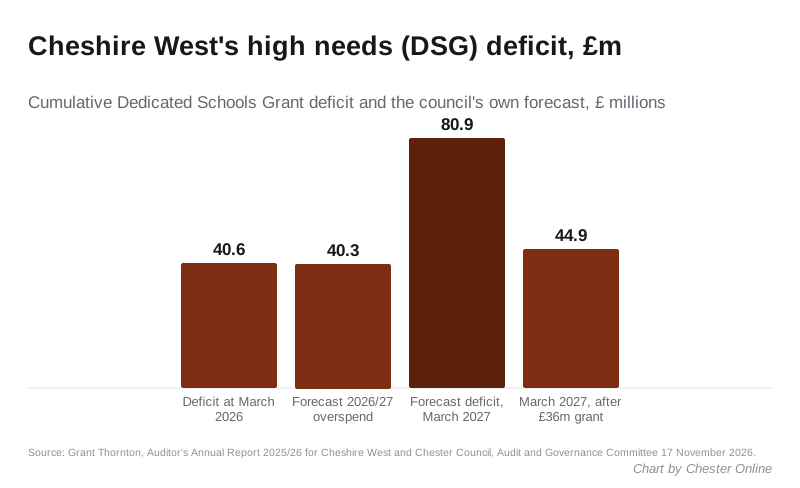
The £36m is a High Needs Stability Grant. The Department for Education confirmed it in October, when it approved the council’s SEND Reform Plan. It covers 90% of the deficit built up to March 2026, cutting that historic figure to £4.6m.
What it does not cover is the deficit still building this year and next. The national accounting rule that keeps these deficits off council budgets, the statutory override, ends in March 2028. The auditor says arrangements for deficits run up before then are “unclear”.
The council’s own budget plan already carries a one-off cost of £12.5m in 2028/29. That is the 10% of a forecast £125m deficit it does not expect the government to cover. It plans to pay it from a long-term liability reserve, which held £24.1m in March 2026, down from £27.3m a year earlier. The auditor warns the cost “may increase”.
Demand is rising faster than the national rate
The number of education, health and care plans (EHCPs) in the borough rose from 3,808 in January 2025 to 4,395 in January 2026. That is a rise of 15.4%, against 12.5% across England, according to Department for Education data the auditor cites.
Plans are also slow to arrive. The legal limit for issuing one is 20 weeks. In 2025/26, 21.4% were issued on time, up from 16.9% the year before. The first quarter of 2026/27 reached 32%, still short of the council’s 40% target for the year. The auditor kept its recommendation from previous years that the council keep working on this.
The wider money picture
The SEND deficit sits alongside the council’s main budget, which is under its own strain. The auditor’s figures for 2025/26:
- the council used £5.4m of reserves to balance its budget, down from £14.5m the year before
- it ended the year £1.4m overspent, after social care and education ran £14.6m over
- it delivered £18.9m of a £29.2m savings target, or 65%, down from 78% the year before
- its general reserve stayed below the minimum the council itself considers prudent
The auditor says that reserve is not expected to return to a prudent level until 2027/28. It also notes the remaining funding gap of £42.3m to 2030/31, which the council reported to Cabinet on 14 October. The latest forecast for this year is a £10.9m overspend, as we reported from the mid-year finance report.
What the auditor wants
Its one key recommendation is that the council “must continue to work urgently with partners” to deliver the SEND Reform Plan. It wants the growing deficit reduced “to a sustainable level across the medium term”, with close monitoring and “timely corrective action where required”.
The auditor credits the council with clear plans and good oversight. It notes the SEND Reform Plan has defined measures, from EHCP delivery and therapy waiting times to tribunals and out-of-area placements. On governance, it found effective internal audit, scrutiny and budget monitoring.
What it means for you
If your child has an EHCP or is waiting for one, the report confirms what many families already know: plans are mostly late, and demand is still climbing faster than elsewhere. The reform plan is the council’s answer, and the auditor will check progress again next year.
If you pay council tax, the SEND deficit is kept off the main budget for now. The government takes on these deficits after March 2028, but the council expects to carry a £12.5m share itself in 2028/29. That comes on top of the £42.3m gap it still has to close. Draft proposals for the 2027/28 budget are expected in January.
What happens next
The Audit and Governance Committee meets at 6pm on Tuesday 17 November. The same agenda carries the council’s final accounts for 2025/26 and the auditor’s findings on them.
Have your say