
31% of North West adults would take in a dead friend's pets but only 18% their older children, a Will Aid poll found. Basic Wills cost a donation this November.
Nearly one in three people in the North West would take in a friend’s dog or cat if the friend died without talking to them about their Will. Fewer than one in five would take in the friend’s older children.
The figures come from a poll for Will Aid, the charity Will-writing campaign that runs every November, published on 16 November. During the campaign, solicitors taking part waive their usual fee for a basic Will and ask for a donation to charity instead.
What the poll found in the North West
Asked what they would agree to take in if a friend died without having spoken to them about their Will, people in the North West said:
- 31% would take in the friend’s pets
- 22% would take in the friend’s younger children
- 18% would take in the friend’s older children
- 26% would not agree to take in anyone or anything
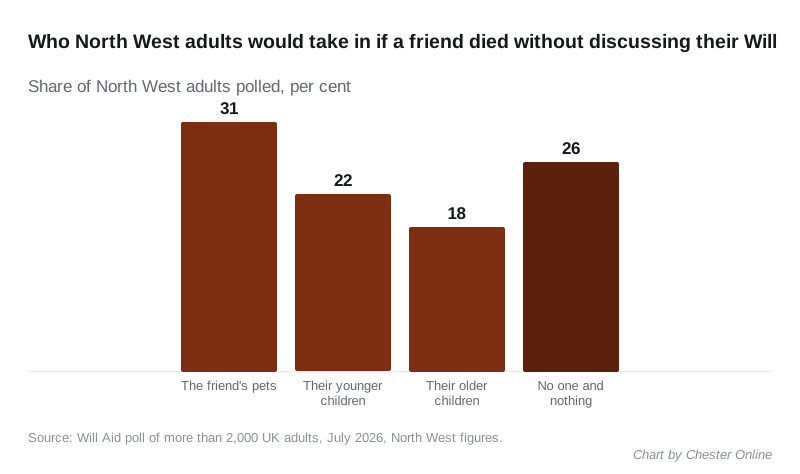
The regional figures are part of a survey of more than 2,000 UK adults carried out in July 2026. Across the UK, 33% would take in a friend’s pets, 27% their young children and 20% their older children. One in four, 25%, would take in no one and nothing.
“Dangerous to leave those decisions to chance”
Peter de Vena Franks, Will Aid’s campaign director, said: “Most of us would like to think that if something happened to us, our friends and family would step in and look after the people and pets we love.
“But these findings reveal just how dangerous it can be to leave those decisions to chance.
“It’s striking that more people would be prepared to take in a friend’s pet than their older children. Of course, caring for a child is an enormous responsibility, and nobody should be expected to make that commitment lightly. But that’s precisely why these conversations need to happen while we’re still here to have them.
“Imagine losing someone you love and, in the middle of your grief, suddenly being asked to make life-changing decisions about their children, their pets or their possessions, without knowing what they would have wanted.
“Nobody wants to put their loved ones in that position.
“A Will isn’t just about who gets the house or the money in your bank account. It’s also about taking responsibility for the people who matter most to you and making sure they aren’t left facing unnecessary uncertainty when you’re gone.”
Willing is not the same as having the legal right
Will Aid points out that agreeing to look after a child or a pet is very different from having the legal authority to do so.
When someone dies, their estate is dealt with under their valid Will or, if there is none, under the intestacy laws. Arrangements for children can be more complicated, particularly where a surviving parent or someone else already has parental responsibility.
A Will can let parents appoint testamentary guardians in the right circumstances, the charity says, although that appointment does not automatically override the rights of a surviving parent.
Donna Imrie of Rollos Law LLP, one of the firms taking part in the campaign, said: “One of the biggest mistakes people make is assuming their loved ones will simply know what to do when they die.
“They might have a friend in mind to look after their children, or a relative who has always said they would take the family dog. But unless those wishes have been properly discussed and appropriate arrangements made, there is no guarantee things will happen as they imagined.”
On children, she said: “Parents should think carefully about who they would want to act as guardian if the circumstances arose, discuss that responsibility with the people concerned and take professional advice about recording their wishes in a legally valid Will.”
And on animals: “Pets need planning too. Owners should consider who would be willing and able to care for them, whether financial provision might be appropriate and how their wishes should be communicated.
“These aren’t always easy conversations, but they are far easier to have now than to leave grieving loved ones trying to work everything out afterwards.
“A professionally drafted Will can help provide clarity, reduce the potential for disputes and ensure your wishes are properly recorded.”
A quarter would take in no one
Mr de Vena Franks said the share who would take in nobody was the most sobering result.
“That doesn’t mean people are uncaring,” he said. “It shows that we cannot simply assume somebody else will be willing or able to take on responsibilities we haven’t discussed with them.
“Making a Will and talking openly about your wishes are two of the most important things you can do for those you love.”
Making a Will through Will Aid in November
Solicitors taking part in Will Aid write basic Wills through November without charging their usual fee, and invite clients to make a voluntary donation instead. Appointments are available now, in person or remotely. To find a solicitor taking part near Chester, enter your postcode on the charity’s find a solicitor page.
Donations are shared between Will Aid’s eight partner charities:
- Age UK
- British Red Cross
- Christian Aid
- Crisis
- NSPCC
- SCIAF (Scotland)
- Shelter
- Trócaire (Northern Ireland)
Source: Will Aid.
Have your say