
Cheshire West's budget tool says a 10% cut could remove up to 300 litter bins and shut a tip. You can respond until 2 December. Checked November 2026.
A 10% cut to Cheshire West and Chester Council’s street cleaning budget could remove up to 300 litter bins and close some play areas, the council’s own budget tool says. The same cut to waste would put a recycling centre at risk of closing and bin collection frequency under review.
Those are not proposals. They come from the budget simulator in the council’s Let’s Talk Budget consultation, which is open until Wednesday 2 December. It asks residents to find £40m, and it shows what each choice could cost. The council calls those consequences “indicative only”, and says more work would be needed to assess any real change.
No service has been named for a cut. Councillors decide the budget on 25 February 2027.
Why the council is asking
The council says it faces a funding gap of around £40m over the next four years. Its consultation paper says more than £20m of that falls next year. It is legally required to set a balanced budget.
Council leader Cllr Louise Gittins said:
“Budgets are always about choices. This means making decisions about how the budget is spent, the services we run, and how the communities you live and work in are supported.”
“We currently face a funding gap of around £40m over the next four years. Unlike most other organisations, we also have a legal obligation to set a balanced budget. This means we cannot spend more than we receive through national funding and local income.”
“We want to continue to protect services for the most vulnerable people in our borough, and continue to invest in the borough’s future as we have done, but the views of our communities have never been more important.”
Cllr Carol Gahan, Cabinet Member for Legal and Finance, said other councils had reported “huge concerns” about keeping services going, and several were already getting extra financial support from central government.
“We are not currently in that position, but we must do everything we can to make sure we continue to live within our means.”
Since the consultation opened, the picture this year has worsened. A report going to Cabinet on 11 November forecasts a £10.9m overspend and puts most recruitment on hold.
What a 10% cut would mean, service by service
The simulator lets you cut most services by 10%, 20% or 30%, or raise them by 5% or 10%. These are its descriptions of a 10% cut.
Bins and recycling centres (£26.1m) - the council “would need to consider the frequency of collections” for residual waste at the kerbside - it would explore staff reductions and closing one of its household waste recycling centres
Streets, parks and play areas (£8.9m) - the removal of up to 300 litter bins - litter collection focused on town centres and shops - less frequent grass cutting, with “up to 14 weeks for mowing” - “a number of play areas” closed, with those in parks the priority to keep
Roads and pavements (£17.0m) - more money spent on reactive pothole repairs, at the expense of planned maintenance - less urgent repairs taking longer - fewer bridge and structure inspections, and less proactive tree work - less road safety funding
Libraries, museums, events and markets (£9.3m) - services reorganised into fewer buildings - shorter opening hours at libraries, archives and museums (the leases with permanent traders rule out cutting market hours) - fewer council-run events and less support for voluntary arts groups
Leisure centres (£3.0m) - specific facilities “may need to close” - charges rising above inflation - Brio “unlikely to continue” its community physical activity services
Care for adults (£195.7m across three budgets) - longer waits for assessments and reviews - possible reductions in telecare, adaptations, reablement and short breaks for carers - mental health services focused on those with the highest need
Children and families (£91.0m), and support to schools (£28.8m) - fewer Family Help staff and higher caseloads - reviewed opening hours at Best Start Family Hubs - some youth services stopping - longer waits for education, health and care plans and school places, and less school transport support
Community safety and trading standards (£6.3m) - fewer community safety officers and wardens - environmental health and trading standards staffing below statutory minimums, which the simulator says would raise the risk to residents, workers and visitors
The simulator’s text for a 10% cut to business support and regeneration describes a 5% increase instead, so it appears to be a mistake on the council’s page. We have left it out.
At 30%, the descriptions get much starker
- Roads: there “might be no planned maintenance programme for roads, pavements and street lighting”, with reactive maintenance for emergencies only.
- Buses: services in rural areas “reduced significantly or removed entirely”.
- Libraries: “widespread closures” and the possible withdrawal of the mobile library. All council-organised events would go.
- Waste: less frequent collections, and only the primary recycling centres kept open.
- Leisure: a range of facilities closed, and charges “substantially above” inflation.
Where the money goes
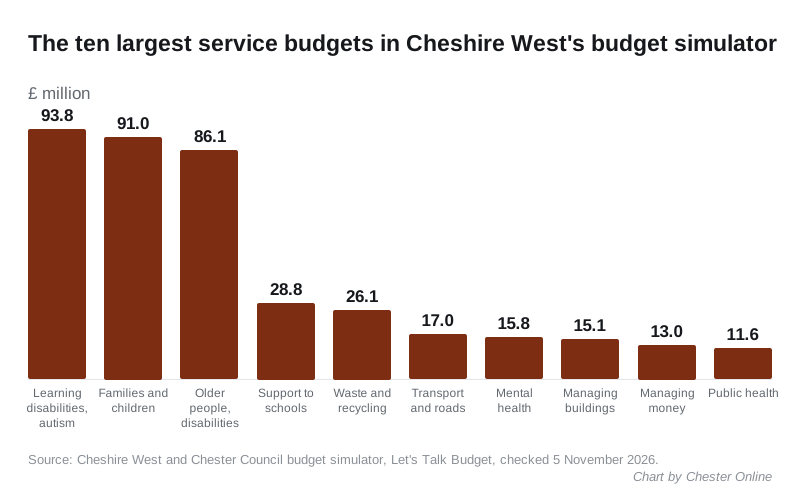
The simulator’s service budgets add up to £455.7m. That is well below the £1bn the council says it spends each year, and the tool does not explain the difference.
| Service | Simulator budget | 10% of that |
|---|---|---|
| Learning disabilities and autism support | £93.8m | £9.4m |
| Families and children | £91.0m | £9.1m |
| Older people and physical disabilities | £86.1m | £8.6m |
| Support to schools | £28.8m | £2.9m |
| Waste and recycling | £26.1m | £2.6m |
| Transport, roads, footpaths and cycle routes | £17.0m | £1.7m |
| Mental health support | £15.8m | £1.6m |
| Managing our buildings | £15.1m | £1.5m |
| Managing our money | £13.0m | £1.3m |
| Public health | £11.6m | £1.2m |
| Events, culture, libraries, markets and archives | £9.3m | £0.9m |
| Clean and green streets | £8.9m | £0.9m |
| Housing and homelessness | £7.3m | £0.7m |
| Governance and support to councillors | £6.8m | £0.7m |
| ICT and equipment | £6.6m | £0.7m |
| Community safety and customer protection | £6.3m | £0.6m |
| Customer services and engagement | £3.8m | £0.4m |
| Leisure centres and sports facilities | £3.0m | £0.3m |
| Support to businesses, regeneration and skills | £1.9m | £0.2m |
| Project and contract management | £1.8m | £0.2m |
| Human resources and training | £1.5m | £0.2m |
| Planning services | £0.3m | £0.03m |
The last column is our arithmetic, not the council’s. A 10% cut to every line would come to about £45.6m, just over the target.
Five budgets for care and children’s support come to £315.4m, or about 69% of the simulator’s total. The other 17 come to £140.3m. To find all £40m from those 17 alone, each would have to fall by about 29%, close to the simulator’s starkest setting.
Council tax, parking and the other income
The simulator also lets you raise income. Its council tax figure is £277.2m, so 1% is worth about £2.8m on our arithmetic.
- Council tax can move from 2% down to 4% up. Going above 3% would need a local referendum, at a one-off cost the council puts at about £650,000.
- The adult social care precept can rise by up to 2%.
- Car parking (£9.1m), commercial rents and markets (£3.0m) and cemeteries, crematorium and registration fees (£2.9m) can each rise by 5% or 10%.
The council’s October financial forecast already assumes a 4.99% rise every year. The simulator does not say whether its £40m target allows for that.
Which £40m?
The simulator says its £40m is “before any of the existing savings that the Council has planned”. The report to Cabinet in October sets it out differently. Its £42.3m gap is what remains after £39.8m of planned savings. That is why the same report talks about savings of over £82m in total.
So the real savings task may be about twice what the simulator asks you to find.
What it means for you
You have until Wednesday 2 December, and there are several ways to respond:
- Online: the survey and simulator, or an Easy Read survey with simpler words and pictures, on the same page
- Email: councilbudget@cheshirewestandchester.gov.uk
- Phone: 0300 123 8123, quoting “Let’s Talk Budget”
- Post: Let’s Talk Budget, Communication and Engagement, Cheshire West and Chester, The Portal, Wellington Road, Ellesmere Port, CH65 0BA
- Paper: copies are in libraries, and other formats are available on request
The survey itself is short. It has two open questions: your views on the council’s approach, and any ideas for saving money or raising income. It does not ask about particular services, so the simulator is the place to show which ones you would protect.
The council says it will publish the findings in January 2027. It adds that proposals which could mean “more significant changes to services” may get further consultation of their own.
Cllr Gittins said:
“I urge everyone to take part in our consultation. Let’s Talk Budget is about the future of our communities as much as the financial sustainability of the Council.”
Have your say